
Every Akway basket is handwoven by one of more than fifty artisan families, and a single piece passes through five distinct stages, from selecting and buying the raw fibre through to the finished weave. It is slow, deliberate work, and it is why made-to-measure custom sizing is possible.
The first time I watched one of our baskets being made, start to finish, I lost track of time. I had driven out to meet a weaver whose family had supplied us for months, and I expected a quick visit. Instead I sat on a low stool in her courtyard for most of the afternoon, watching reeds turn into something you would happily put in your living room. Nobody rushed. Her hands knew the rhythm so well she barely looked down.
I started Akway because I believed handmade still mattered, even in a world that can ship you a plastic bin overnight. Every basket we sell is woven by hand, by real people, in real homes and small workshops across India. We work with more than fifty artisan families, and this is the story of how they turn a bundle of natural fibre into the basket that ends up in your kitchen, bathroom or bedroom.
I want you to know whose hands made your basket, why that takes the time it does, and how we can weave one to your exact size when nothing off the shelf fits. So let me take you from reed to finished basket, the same way I learned it.
From reed to basket
A handwoven basket is not a quick thing. Most of ours pass through five clear stages, and each one matters to how the basket looks and how long it lasts. Here is roughly how the time breaks down for a single piece.
| Stage | What happens | Time |
|---|---|---|
| Sourcing the fibre | Selecting and buying natural rattan, cane, bamboo, wicker or seagrass, checking each bundle for strength and colour. | Ongoing, in batches |
| Soaking and prepping | Soaking the fibre so it bends without snapping, then splitting, trimming and sorting it by thickness. | A few hours to overnight |
| Weaving the base | Laying the spokes and weaving the flat base, the part that decides whether the basket sits square and steady. | 1 to 2 hours |
| Building the walls | Weaving the sides up row by row, keeping tension even so the shape stays true all the way to the rim. | 3 to 6 hours |
| Finishing | Binding the rim, adding handles or a lid, trimming stray ends, and a final check before it ships. | 1 to 2 hours |
Add it up and a single basket can take the better part of a day of focused work, sometimes spread over two as the fibre dries. That is the part a price tag never quite explains.
The hands behind the weave
Numbers are easy to type and hard to feel. So let me tell you about the people behind them.
The families
We work with more than fifty artisan families across India. Some weave from home, with the day's work piling up beside them while tea goes cold. Others work in small village workshops where three generations might be in the same room. They are not a faceless factory line. They are people I have met, whose names I know, whose work I can recognise by the tightness of a weave or the finish on a rim.
Weaving is slow, and it is honest. A weaver cannot fake a clean base or hide a loose row. When you run your hand along an Akway basket and it feels solid and even, that is years of practice you are touching, not a machine setting.
Skills passed down
Most of the weavers we work with did not learn this from a manual. They learned it the way you learn a language at home, by watching a parent or grandparent and copying, badly at first, then better. A child sits nearby, hands a reed, gets corrected, tries again. Years later their hands move without thinking.
That is also why this craft is fragile. When younger people leave for city jobs, the knowledge can quietly disappear. Part of why I keep Akway focused on handmade is simple: steady orders give these families a reason to keep weaving, and a reason to teach the next person. Every basket you buy is a small vote for that skill staying alive.
Natural fibre, not plastic
We weave with natural materials only: rattan, cane, bamboo, wicker and seagrass. These are not interchangeable, and they do not even reach the workshop by the same route. Rattan and cane bend into smooth, strong frames. Bamboo brings structure. Seagrass and kauna grass give a softer, finer texture for lighter baskets. A good weaver knows which fibre suits which basket, the same way a cook knows which rice suits which dish.
Plastic baskets are cheaper and faster, and I understand the appeal. But natural fibre breathes, ages gracefully and goes back to the earth when its life is over. It also simply looks and feels better in a home. A plastic bin announces itself. A handwoven basket quietly belongs.
Made to measure
Here is the part I am proudest of. Because everything is woven by hand, we are not locked to standard sizes. If your modular kitchen drawer, your wardrobe shelf or that awkward corner needs a basket that no shop seems to stock, our artisans can weave one to your exact measurement. You send the internal width, depth and height. They weave to it. Custom sizing usually takes about 7 to 8 working days and, in most cases, costs the same as a standard basket.
Shop their handiwork
Here are a few baskets our artisan families weave, ready to bring home. Each one is fully handmade from natural fibre, and any of them can be made to a custom size if you ask.

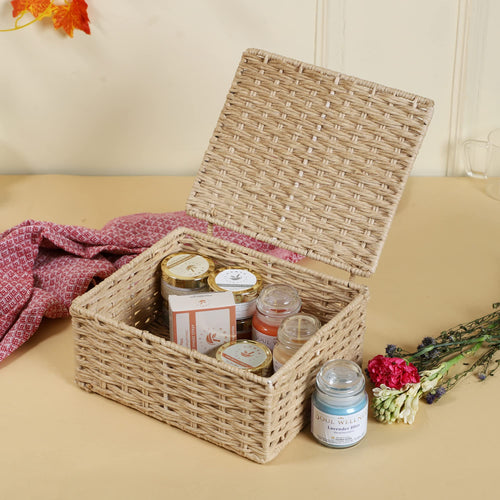
Seagrass Storage Basket with Lid - Ishani
A finely woven seagrass basket with a lid, perfect for keeping small things tidy and out of sight.
From Rs 899
Shop Now
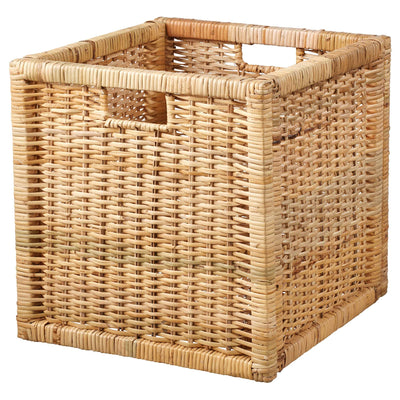
Wicker Wardrobe Storage Basket - Anuja
A handwoven wicker basket sized for wardrobe shelves, holding clothes, linens and odds and ends.
From Rs 2,399
Shop Now
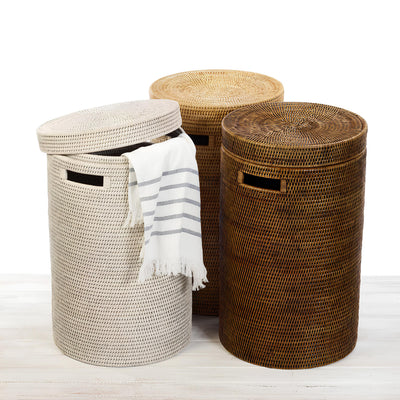
Rattan Laundry Basket with Lid (Small) - Akanksh
A compact rattan laundry basket with a lid, woven to keep a bathroom looking calm and clutter-free.
From Rs 3,199
Shop Now
Rattan Laundry Basket for Bathroom - Hem
A roomy rattan and bamboo laundry basket, hand-woven with an even weave that wears beautifully.
From Rs 3,299
Shop Now
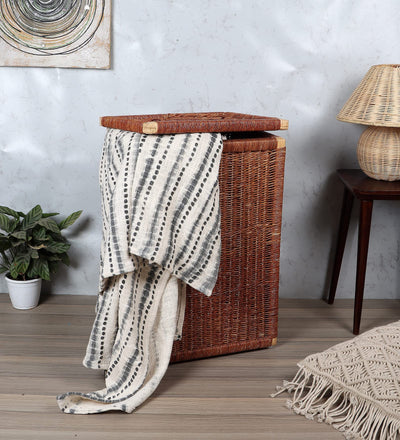
Rattan Laundry Basket with Lid - Alex
A generous rattan laundry basket with a lid, a quiet, premium piece for a bedroom or bathroom.
From Rs 5,499
Shop NowWhy does handmade matter?
It would be easier and cheaper to sell machine-made plastic. We choose not to, and here is why that choice is worth it for you too.
- Real people, real income: every basket supports an artisan family and helps keep a traditional craft alive.
- Built to last: a hand-woven natural basket, looked after, lasts years, while plastic cracks, fades and yellows.
- Breathable and natural: the open weave lets air move, so clothes and dry goods stay fresher than in sealed plastic.
- Kind to the earth: rattan, cane, bamboo and seagrass are renewable and biodegradable, with no plastic smell.
- One of a kind: no two handwoven baskets are identical, and that small variation is the proof a person made it.
- Made to fit you: because it is handmade, we can weave it to your exact size when standard ones do not work.