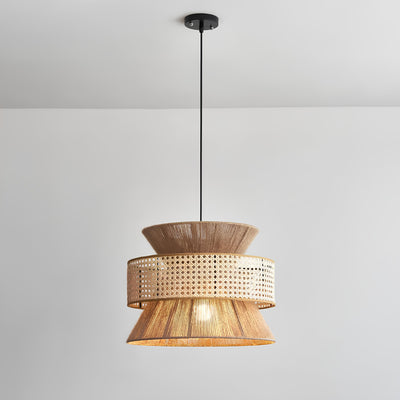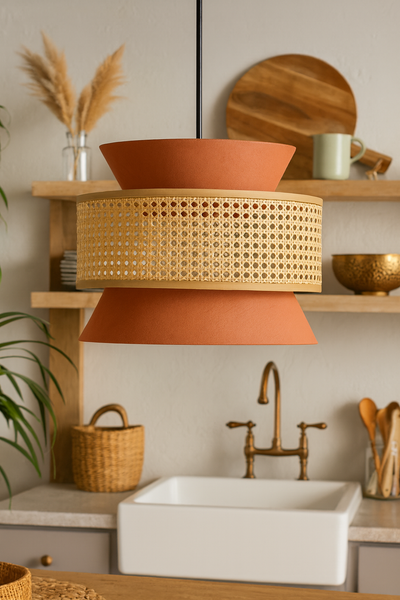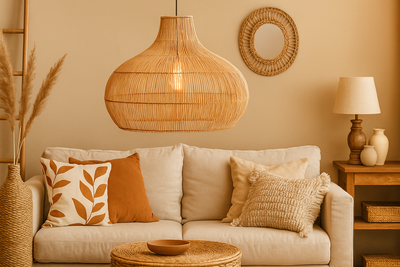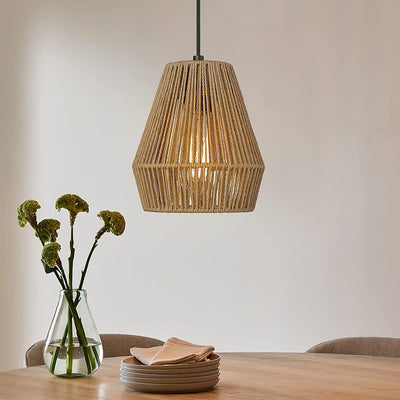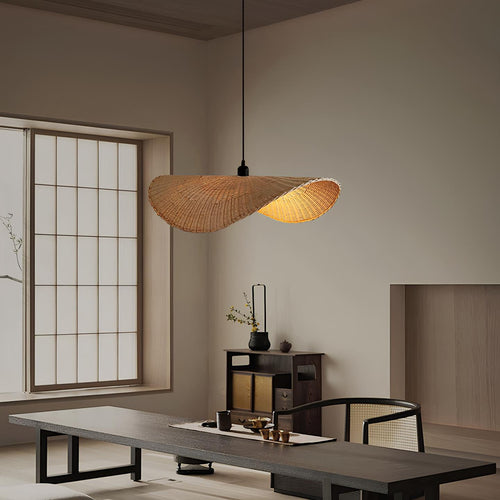

Hang a dining pendant 75 to 85 cm above the tabletop, and size it to the table: 30 to 35 cm wide for a round table up to 90 cm, 35 to 40 cm for a four-seater, and one pendant of 40 cm or more for a six-seater.
A pendant light over the dining table is one of those things that looks easy until you actually hang one. Pick the wrong size and a tiny lamp floats over a six-seater like a lost balloon. Hang it too high and the room feels cold and unfinished. Hang it too low and everyone at dinner is squinting around it to see each other. Most people get one of these three things wrong, and the fix is almost always free: it is just about size, height and number.
This guide walks through the numbers that actually work for Indian dining rooms, whether you have a cosy four-seater or a long eight-seat table. We will cover how high to hang a pendant, how wide it should be, when to use one big light versus a row of three, and which warm-glowing rattan, bamboo, cane and wicker pendants we make for the dining table at Akway.
The short version: hang the bottom of the pendant about 75 to 90 cm above the tabletop, and make the total lit width roughly half to two-thirds of your table's length. Get those two numbers right and almost everything else falls into place.
Quick answer: size, height & number
If you only read one section, read this. Match your table length to the pendant setup and hanging height below, and you are ninety percent of the way there.
| Table length | Pendant setup | Hanging height (above tabletop) |
|---|---|---|
| Round table, up to 90 cm | One pendant, 30 to 35 cm wide | 75 to 80 cm |
| 4-seater, 90 to 120 cm | One pendant, 35 to 40 cm wide | 75 to 85 cm |
| 6-seater, 150 to 180 cm | One large pendant (40 cm+) or two medium | 80 to 85 cm |
| 8-seater, 200 to 240 cm | A row of three pendants or one statement cluster | 80 to 90 cm |
| Long bench / 10-seater, 240 cm+ | Three large pendants, evenly spaced | 85 to 90 cm |
These heights assume a standard 75 cm tall dining table and a ceiling around 2.7 to 3 metres. Taller ceilings can take a few extra centimetres of drop, and very low ceilings should sit at the higher end of the height range so nobody bumps their head.
How do you choose a dining pendant?
Choosing a dining pendant comes down to a short, repeatable checklist. Work through it in order and you will not second-guess yourself at checkout.
- Measure your table length and width with a tape, and note your ceiling height.
- Decide on width: the total pendant (or row of pendants) should span roughly half to two-thirds of the table's length.
- Pick the height: the bottom of the shade should sit 75 to 90 cm above the tabletop.
- Choose one big light, two mediums or a row of three based on table shape (more on this below).
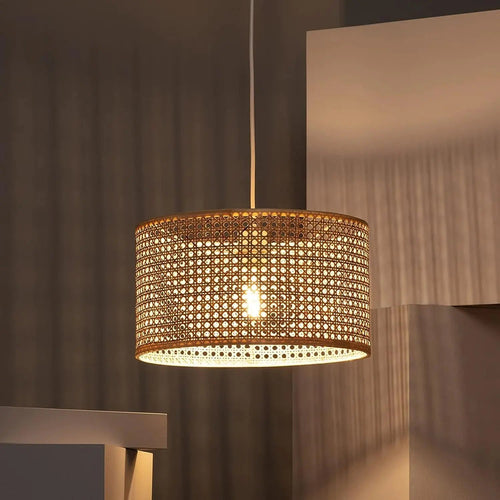
- Match the material and finish to your room. A warm rattan or bamboo weave suits Japandi, boho and modern Indian interiors and casts a soft, dappled glow.
- Plan the bulb and dimming before you buy, so the light is warm and adjustable from day one.
One big pendant vs a row of three
This is the decision people agonise over most, and it really comes down to the shape of your table.
When one big pendant wins
A single large pendant is the cleaner, calmer choice for round tables, square tables and shorter rectangular ones up to about 150 cm. One generous rattan or bamboo shade becomes the centrepiece, throws an even pool of warm light, and keeps the ceiling visually quiet. It is also the easiest to install, since there is only one ceiling point to wire and one drop to get right. For most four-seaters and round tables in Indian homes, one good pendant is all you need.
When a row of three wins
Long rectangular tables, the kind that seat six to ten, look unbalanced under a single light. A row of three matching pendants spreads the glow evenly from end to end so the people at the far seats are lit just as well as those in the middle. Space them so the outer two sit above where the end diners eat, not right at the table edges, and keep equal gaps between all three. Three smaller cane or jute pendants in a line also feel more relaxed and layered than one oversized fixture straining to cover the whole table.
The middle ground: two pendants or a cluster
For a tricky 150 to 180 cm table, two medium pendants split the difference nicely. A cluster, where three or more shades hang at staggered heights from one central point, is the statement option: it reads as one sculptural piece but still spreads light across a wider table. Clusters of woven rattan shades look especially good over a six-seater in an open-plan room.
Our dining pendants & chandeliers
These are our most popular handwoven pendant lights for the dining table, each made by Indian artisan families from natural rattan, bamboo, cane, raffia or jute. They cast the warm, textured glow that makes dinner feel special. Lamps are listed lamps-first, dining-friendly sizes at the top.

Rattan & Bamboo Pendant - Reva
Our dining-room hero. A wide 14 inch rattan and bamboo shade that throws a warm, dappled pool of light over four to six seats.
From Rs 2,899
Shop Now
Bamboo & Rattan Pendant - Laksh
A 14 inch woven dome that works beautifully as a row of three over a long six or eight-seater. Even glow, end to end.
From Rs 2,799
Shop Now
Bamboo & Cane Pendant - Ahalya
A 12 inch cane pendant, perfect as a single light over a round table or four-seater, or paired in twos over a longer one.
From Rs 2,099
Shop Now
Rattan & Bamboo Pendant - Shanaya
A budget-friendly woven pendant with classic rattan texture. A great-value choice for a single light over a compact dining table.
From Rs 1,899
Shop Now
Raffia Statement Pendant - Advik
A larger raffia shade for those who want a single statement piece over a six-seater. Soft, natural texture and a generous warm spread.
From Rs 3,699
Shop NowBulbs & dimming
The fixture is only half the job. The bulb decides whether dinner feels warm and inviting or like a hospital canteen. Get this right and even a modest pendant looks expensive.
- Go warm, always: choose 2700K (warm white) bulbs for the dining table. This is the soft, golden tone that flatters food, skin and a woven rattan shade. Skip cool white and daylight bulbs over a table, they kill the mood.
- Right brightness: aim for roughly 400 to 700 lumens per pendant over a table. Bright enough to see your plate, soft enough to linger after dinner.
- Add a dimmer: a dimmable LED plus a dimmer switch lets you go bright for homework and dinner prep, then low and golden for guests. It is the single best upgrade you can make.
- Mind the glare: with an open or semi-open woven shade, use a frosted or filament-style bulb so the source is not harsh when you look up. Rattan diffuses light beautifully but does not fully hide a bare bulb.
- Match all bulbs: if you hang a row of three, use identical bulbs in colour and brightness so the line of light looks even.
Common mistakes
Almost every dining-pendant regret comes down to one of these. Check yourself against the list before you drill.
- Hanging it too high: a pendant that sits up near the ceiling stops feeling connected to the table and leaves the surface dim. Bring the bottom down to 75 to 90 cm above the tabletop.
- Buying too small: a single petite pendant over a long table looks lost. Size to half to two-thirds of the table length, or use a row of three.
- Centring over the room, not the table: the pendant must hang over the middle of the table. If you ever move the table, you will need to move the light too.
- Cool white bulbs: daylight bulbs over a dining table feel clinical. Stick to 2700K warm white.
- No dimmer: one fixed brightness rarely suits both a working dinner and a relaxed one. A dimmer fixes that for a few hundred rupees.
- Uneven spacing in a row: three pendants bunched in the centre look like a mistake. Space them evenly across the table length with matching gaps.