Choose a bedside table by three things, in this order: the height of your mattress, whether you need a drawer or an open shelf, and what the frame is actually made of. Get those right and the price sorts itself out. In India a solid one starts around Rs 3,899.
Most bedside table advice is about styling — the tray, the lamp, the stack of books. That matters, and we have a whole guide to bedside table styling. This one is about the decision you make before any of that: which table to buy, and how to tell a good one from a bad one while it is still a photo on a screen.
What does a bedside table actually cost in India?
Below roughly Rs 3,000, you are almost always buying particleboard or MDF wrapped in a printed wood-look foil. It looks convincing in the listing photograph and it works fine in a dry bedroom. It also cannot be repaired, and it will not survive being moved between flats more than once or twice.
Above that, you are paying for solid timber or a woven frame, and the jump in lifespan is much bigger than the jump in price. Here is what each band buys from our own range, so the numbers are real rather than illustrative:
| Type | Price range | What you are getting |
|---|---|---|
| All-rattan or cane | Rs 3,899 – 9,699 | Woven frame, usually an open shelf. Lightest to move, most texture |
| Wall-mounted or floating | Rs 7,199 – 9,399 | No floor footprint at all. The small-bedroom answer |
| Rattan front, mango wood frame | Rs 7,499 – 12,999 | Solid frame with a woven drawer front. Storage plus texture |
| Solid mango wood | Rs 7,599 – 18,999 | Heaviest and longest-lived, usually with one or two drawers |
Mango wood, rattan or engineered board?
This is the decision that determines whether the table is still in use in ten years, so it is worth more than the thirty seconds most people give it.
Solid mango wood is a dense hardwood, and it is the most forgiving choice. Dents sand out. A loose joint can be re-glued. It is heavy, which is exactly what you want in something you lean on half-asleep, and it takes a drawer far better than any board product.
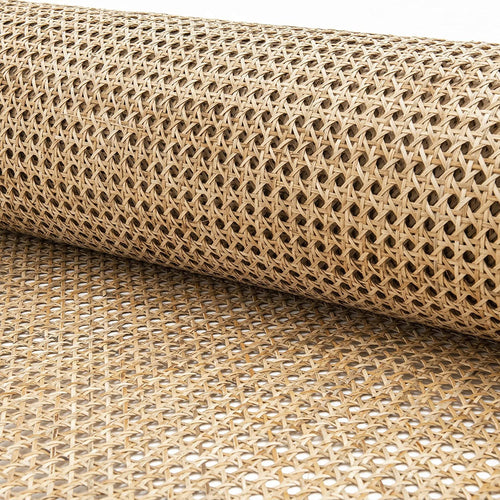
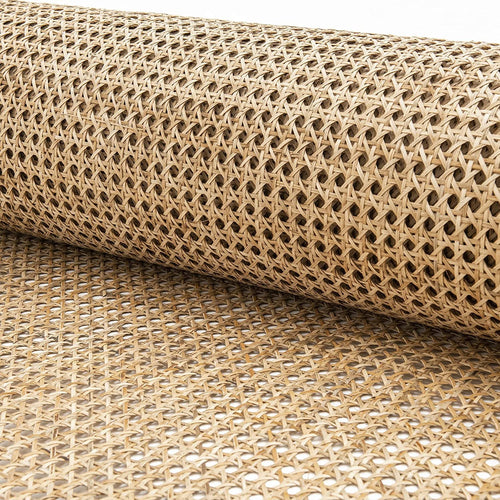
Rattan and cane come from a climbing palm with a solid stem, unlike bamboo, which is hollow (FAO, Taxonomy, Biology and Ecology of Rattan). That solid core is why a slender cane frame carries real weight without the wall thickness a bamboo pole would need. Rattan is also the lightest option by a wide margin, which matters if you rearrange a room often.
Engineered board — MDF, particleboard, plywood with a foil wrap — is the one to think hardest about. It is dimensionally stable in dry air, but once water gets past the edge banding, the board swells and never returns. A solid-wood top marked by the same glass can be sanded flat.
That difference comes down to how the material handles moisture. Wood is hygroscopic: it continuously takes up and gives off water with the surrounding air, and shrinks and swells as it does (USDA Forest Service, Wood Handbook, ch. 4). Solid timber moves and settles. Compressed board absorbs and stays swollen.
Do you need a drawer, an open shelf, or both?
Be honest about what actually lands on your nightstand every night. A drawer hides things: charging cables, medicine strips, reading glasses, the stuff that makes a bedroom photograph badly. An open shelf displays them, costs less, and quietly punishes you for owning clutter.
The practical split we see: people who read in bed want the shelf, because a book lives there permanently and a drawer just makes it a two-step reach. People who charge a phone and keep medicines beside the bed want the drawer.
One caveat for coastal and monsoon cities. A closed drawer that never gets opened is a small sealed pocket of air, and controlling moisture is the whole of controlling mould (US EPA, Mold Course, chapter 2). If you keep a drawer packed and shut from June to September, pull it fully open for an hour every few weeks and let it breathe.
How do you tell a well-made bedside table from a cheap one?
You can do most of this from the listing, and the rest in the first minute after it arrives.
- Look for a stated wood, not a mood. "Solid mango wood" is a claim. "Wooden finish", "engineered wood" and "premium wood" are all ways of not saying particleboard.
- Check the weight in the specification. Solid timber is heavy and the number is hard to fake. A full-size nightstand listed at four or five kilograms is board, whatever the photograph suggests.
- Find the back panel. This is where cost is cut first — a thin sheet stapled into a rebate. If a listing never shows the back, assume the worst.
- Ask how the drawer runs. Wooden runners or metal slides both work. What fails is a drawer with no runner at all, dragging on the frame; it will bind within a year.
- Twist one corner when it arrives. A properly jointed frame resists. If it flexes into a parallelogram, the joints are stapled and glued rather than jointed.
- Press the weave. On rattan and cane, it should spring back. A weave that holds a dent was worked dry or is already brittle, and the edges are where it will unravel first.
Height and clearance: two measurements to take first
Take these before you shop, because they eliminate most of the catalogue in one go. Measure from the floor to the top of your mattress — not the bed frame, the mattress, since that is the surface your hand actually travels from. Then measure the clear gap between the side of the bed and the wall or wardrobe.
As a rule the table top wants to sit within about five centimetres of the mattress top, and you want at least a hand's width of air between the table and the bed so bedding does not constantly drag across it. Our styling guide has the full height and width chart by bed size if you want the exact numbers for a single, queen or king.
If the gap beside your bed is under about 35 cm, stop looking at floor-standing tables. A wall-mounted shelf or a floating table gives you a surface without a footprint, and it is the single most effective fix for a tight bedroom. Moving the lamp onto the wall frees up most of what is left.
Our handwoven bedside tables
Five that cover the range, from the lightest cane table to a solid mango wood piece built to outlast the bed it stands next to.

All-cane frame with an open shelf. The lightest table here and the easiest to move, which makes it the sensible first nightstand for a rented flat.
From Rs 3,899
Shop Now
Rattan & Mango Wood Bedside Table - Amara
Woven rattan drawer front on a solid mango wood frame. The compromise most people actually want: real storage, without a slab of plain wood beside the bed.
From Rs 7,499
Shop Now
Rattan & Wood Wall-Mounted Bedside Table - Gemma
Mounts on the wall, so it takes no floor at all. If the gap beside your bed is too tight for a standing table, this is the piece that solves it.
From Rs 8,499
Shop Now
Mango Wood Nightstand with Drawers - Agrima
Two drawers in solid mango wood, for the bedside that has to hold medicines, cables and everything else out of sight. Heavy enough to lean on properly.
From Rs 12,999
Shop Now
Mango Wood Bedside Table for Bedroom - Firella
The one to buy if you are furnishing a bedroom once and properly. Solid throughout, in a deeper walnut-toned finish that sits well with darker beds.
From Rs 18,999
Shop NowLiving with wood and cane through an Indian monsoon
Because solid wood takes up and releases moisture with the air around it, it needs a little room to do so. Leave a couple of centimetres between the back of the table and an external wall — the wall is the coldest, dampest surface in the room during monsoon, and pressing furniture flat against it is what causes the back panel to bloom and the finish to lift.
Wipe spills as they happen rather than at the end of the day; a water ring is a moisture mark, and on solid wood it is reversible if you catch it early. Keep cane out of long hours of direct sun, which is what makes a weave brittle and pale. If a caned shelf slackens slightly in dry months, that is the weave responding to the air and it will usually tighten again when the humidity returns.
Mistakes to avoid
- Buying to fill the gap rather than to the mattress. A table that fits the floor space but sits 15 cm below the mattress is a table you will reach down into every night.
- Assuming two drawers beat one. Two shallow drawers hold less usable volume than one deep one, and cost more to build.
- Ordering a matching pair months apart. Weave and stain vary between batches. Side by side, a small difference reads as a mistake.
- Paying for a lamp-sized top. Measure your lamp base. A 25 cm top with a 20 cm lamp base on it is not a bedside table, it is a lamp stand.