
A chandelier can go on a false ceiling, but the false ceiling must never carry it. Gypsum and POP boards are a thin skin hung below the concrete slab. The weight has to go up to the slab through a hook or rod, or to a support built into the frame for that purpose.
Why can't gypsum or POP hold a hanging light on its own?
A false ceiling in an Indian home is usually a light metal frame hung from the slab on thin hangers, with gypsum boards screwed to it or POP plastered over it. The frame is designed for the boards and whatever the contractor planned for. A hanging light adds weight at a single point, and it moves: the draught from a ceiling fan sways it, and every cleaning or bulb change pulls on it.
Screws driven into gypsum board can work loose under that kind of load, and POP is brittle, so it tends to crack around a fixing. None of this shows on the day of installation. It shows months later as a hairline crack round the canopy or a light that has started to tilt. The fix is always the same: the board is only a cover, and the load goes past it to something solid.
The same principle runs through our guide to hanging a jhula safely, which deals with a moving load. A light is a much smaller, static load, but it still belongs on the slab.
What should you ask the false-ceiling contractor before the boards go up?
Once the ceiling is closed, every change means cutting and patching. Book the ceiling contractor and your electrician for the same site visit and go through these questions together.
- Can every hanging-light point be marked on the drawing and on the slab now? Bring the product listing, so they know the size of each fixture. Keep hanging lights away from the fan point; our note on pendants in a room with a ceiling fan explains why.
- How will each point be carried? A hook anchored into the slab, a rod dropped from the slab, or a support built into the frame. Ask to see it before any board is fixed.
- Is the slab clear at that spot? Beams and concealed conduit decide where a hole can be drilled. The electrician should confirm this before anyone drills.
- What is the gap between slab and board? It decides how long a rod has to be, and whether the light's canopy can cover the opening.
- Where will the junction box sit, and can it be reached later through the canopy opening without cutting the ceiling?
- Will the opening in the board be smaller than the canopy, so the cut edge stays hidden?
- Can each point be photographed with a tape measure in the frame before the board closes? Those photos save a lot of guesswork when a light is changed years later.
Ask the seller for the fixture's weight rather than guessing it, and pass it on. Deciding how a point is anchored is the contractor's and electrician's call, not a homeowner's.
Hooks, rods and plates in plain words
You will hear these names on site. Knowing what each one is makes the conversation with your electrician much easier.
| Name | What it is | Typical use |
|---|---|---|
| Ceiling hook | A J-shaped or eye-shaped hook fixed into the slab with an anchor made for concrete | Pendants and chandeliers that hang on a chain or cable |
| Drop rod | A threaded rod fixed to the slab that runs down through the false ceiling, ending in a hook or plate | When the board sits well below the slab |
| Mounting plate or crossbar | A metal strip screwed to the slab or a support, which the light's canopy fixes to | Flush and close-to-ceiling lights |
| Fan hook | The hook many RCC slabs have cast in at the centre of the room | Sometimes reused for a chandelier, if your electrician confirms it; a fan and a chandelier cannot share one |
| Swag hook | A second hook a little away from the ceiling point, with the cable looped across to it | Moving a pendant over a dining table without moving the point |
Anchors meant for walls are not a substitute for ones meant for hanging loads from concrete. Leave that choice to the electrician.
No false ceiling? Fixing straight to the slab
Many Indian flats have a bare RCC slab with concealed conduit and one light point, usually near the centre of the room. That is good news for a hanging light: the slab can take a hook or plate directly, and the canopy covers the fixing. Your electrician drills the anchor beside the existing point, after checking where the conduit runs.
If the point is in the wrong place, there are two routes. A swag hook moves the pendant sideways, with the cable looped neatly across the ceiling. Or the electrician runs a new point in surface conduit, which is quicker than chasing the slab but visible. On a low slab ceiling, a close-to-ceiling light often works better than a long pendant; the bamboo flush mount collection has woven shades that sit close to the slab.

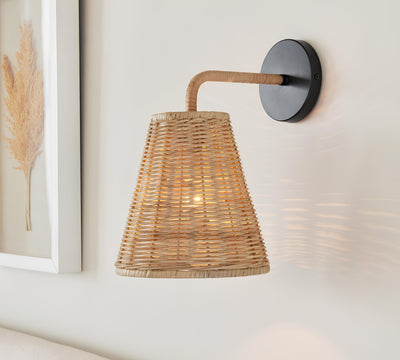
Bamboo Ceiling Light - Adeline
A 14-inch bamboo shade that mounts close to a bare slab, for rooms with no false ceiling.
Rs 2,499
Shop Now
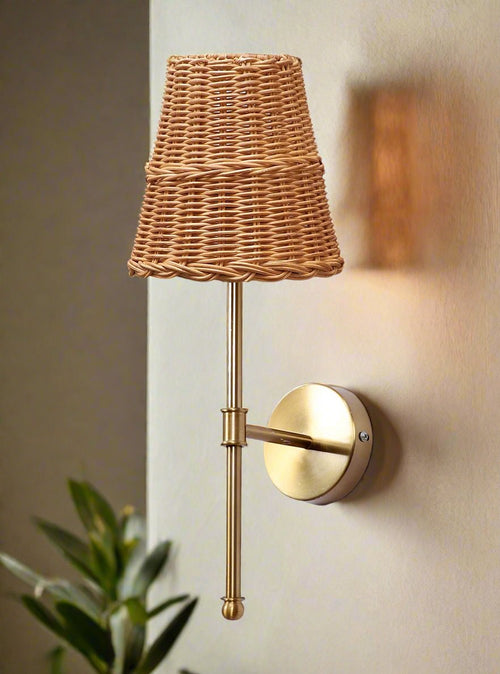
A shallow 6-inch-high cane shade for low slab ceilings, where a hanging light would sit too low.
Rs 1,899
Shop NowHeavy and oversized chandeliers: what changes?
Nothing changes in principle. Every large piece goes to the slab, never to the frame. What changes is the planning around it.
- Get the weight and the hanging method from the seller first. Some pieces hang from one point on a cable or chain; a long linear piece may need two points. Mark every point before the ceiling closes.
- Two people for the lift. One holds the chandelier while the electrician fixes and connects it. The piece should never hang on its wires while that happens.
- Handle woven shades by the frame. A large rattan or wicker shade is rigid across its frame but can dent if squeezed at the weave.
- Keep clear of the fan's reach. A big shade in a fan draught sways more than a small one. Our guide to large rattan chandeliers covers sizing them to the room.

A 42.5-inch statement piece: plan its slab point and the lift before the false ceiling is boarded.
Rs 21,999
Shop Now
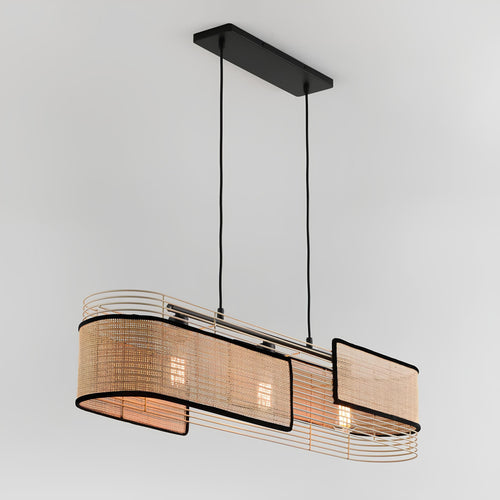
A 48-inch linear rattan piece for a long dining table; confirm its fixing points with your electrician first.
Rs 14,999
Shop NowAlready boarded? Adding a light to a finished false ceiling
It can still be done, but the load still has to reach the slab. The electrician cuts an opening at the chosen point, fixes a rod or hook to the slab above, and brings it down through the hole. The canopy then covers the opening.
Gypsum board is cut and patched cleanly. POP is plastered in place, so repairs usually mean re-plastering and repainting a wider patch. Either way, keep the opening smaller than the canopy. If you are moving a dining light, our guide to pendant lights over a dining table gives the heights to plan the new point around.