
In a kitchen without an island, put the ceiling lights over the counters, not in the middle of the floor. A light behind you throws your own shadow onto the chopping board. Parallel and L-shaped kitchens need a point over each counter run, and a pendant belongs only over a counter you sit at.
Why does the centre ceiling light fail in an Indian kitchen?
Most flats come with one ceiling point in the middle of the kitchen, and it is the wrong place for nearly every job you do there. You stand facing the wall counter to chop, knead and cook, so a light in the centre of the room is behind you. Your head and shoulders block it, and the patch you are working on sits in your own shadow.
Wall cabinets make it worse. Upper cabinets cut off the light from the centre before it reaches the back of the counter, which is exactly where the gas stove, the mixer and the chopping board live. The chimney hood lights the hob with its own lamp, but everything either side of it is left dim. A brighter bulb in the same central point does not fix this; moving the light over the counter does.
Where should the ceiling points go in each layout?
The rule is the same in every shape of kitchen: put the light above the front edge of the counter, slightly in front of where you stand, so it falls on the work surface and not on your back.
| Layout | Where the ceiling points go | What to fit | Pendant? |
|---|---|---|---|
| Straight (single wall) | A line along the counter's front edge | Flush mounts or task lights | Only over a dining nook opposite |
| Parallel (galley) | One line over each counter | Flush mounts, one per counter | Over a breakfast counter at an open end |
| L-shaped | One point over each arm, near the corner if the arms are long | Flush mounts; a pendant over any free floor for a table | Over a small table in the open corner |
| U-shaped | One point over each of the three runs | Flush mounts; the base of the U is the one that goes dark first | Rarely; there is seldom a seat |
Parallel kitchens are the most common shape in Indian flats, with the hob and sink on one side and the storage counter on the other. A single point centred between the two counters can work if the passage is narrow, but two points, one over each counter, give far better light where you actually stand. L-shaped kitchens have a dark corner where the two arms meet; a point over each arm fixes it. In a U-shaped kitchen, the base of the U is the counter people forget, and it is usually where the sink is.
How many ceiling lights does a kitchen need?
Count counter runs, not square feet. Each run you work at needs its own light over it, and any spot where people eat needs one more. That gives two for a parallel kitchen, two for an L-shape, three for a U-shape and one or two for a straight kitchen, plus one over a breakfast counter or table if you have one.
Ask your electrician to put the points on separate switches. That way you can light just the counter you are using, and switch on the pendant over the table without the whole kitchen coming up. Adding or moving a ceiling point, especially on a concrete slab with no false ceiling, is a job for a licensed electrician, not a DIY one.
What should you fit over a counter with wall cabinets?
A flush mount. Over a working counter there are cabinet doors opening, a chimney hood and people moving quickly, and a fitting that sits tight to the ceiling has nothing to bump into and nothing to swing. It also suits the low slab of most flat kitchens. For sizing a flush mount against your ceiling height, our bamboo flush mount guide goes through the numbers.
Keep any woven shade away from the hob and the chimney outlet. Cooking fumes carry grease, and a rattan or bamboo weave near the stove will collect it. Place the woven light over the prep counter or the storage side, dust it weekly with a dry brush, and let the chimney's own lamp handle the stove.

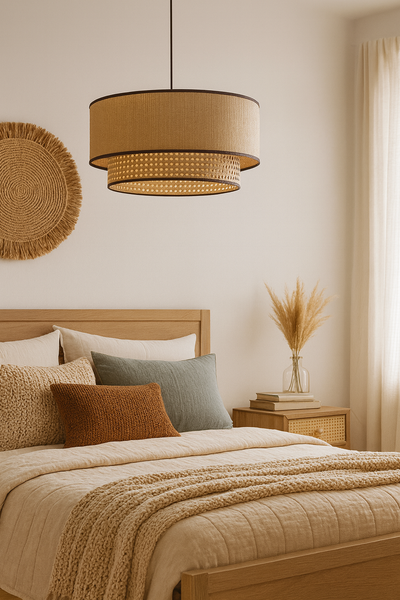
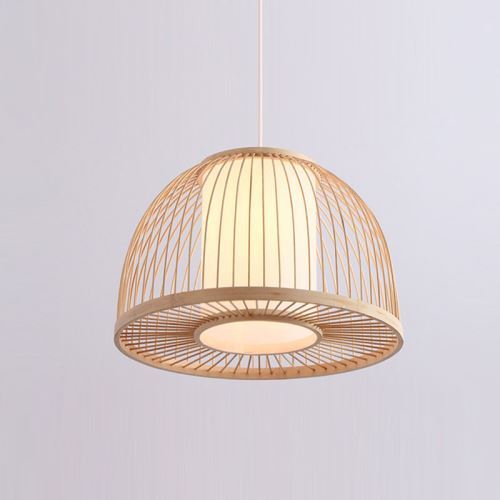
At 16 inches across and 8 inches deep, it spreads light along a counter run without dropping into head room.
Rs 2,299
Shop NowWhere does a pendant make sense without an island?
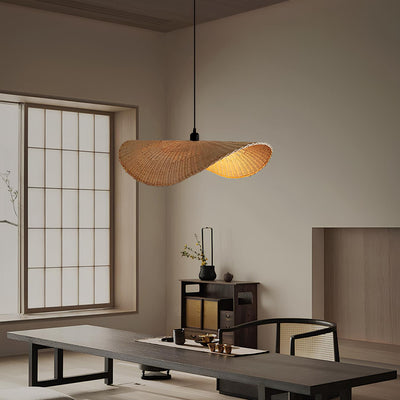
A pendant earns its place over a surface you sit at: a breakfast counter along the open side of a parallel kitchen, a kitchen partition with stools, or a small dining table in the corner of an L-shape. There it lights the table, gives the kitchen a centre and is out of the way of the work zone.
For the drop height over a table and the question of one pendant or two, our dining table pendant guide covers it. If your breakfast counter is long enough to take a row, the spacing rules in our kitchen island pendant guide apply to a counter just as well. You can compare shapes and sizes in our kitchen hanging lights range.
Two places a pendant does not belong: over the sink under wall cabinets, where it will be splashed and there is rarely the height, and over the hob.

A compact 9-inch shade that suits a narrow breakfast counter, alone or as a matching pair.
Rs 1,699
Shop Now
Bamboo Hanging Light - Anahita
Comes in four sizes, from 12 to 20 inches, so you can match it to a small nook table or a bigger one.
From Rs 1,799
Shop NowIs there a place for a wall light in a kitchen?
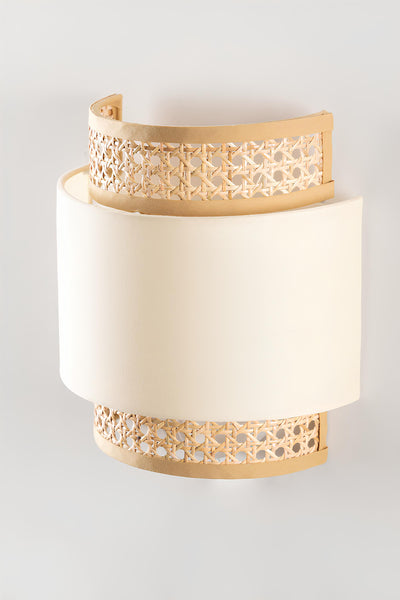
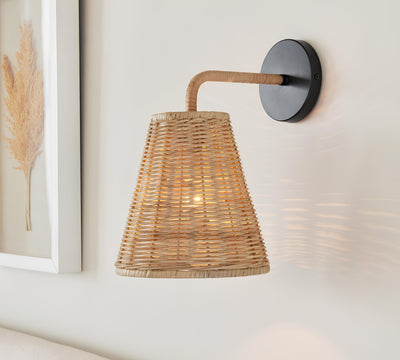
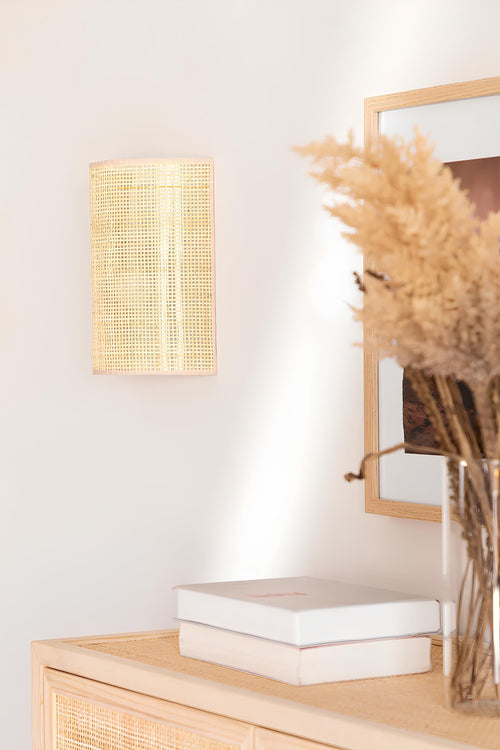
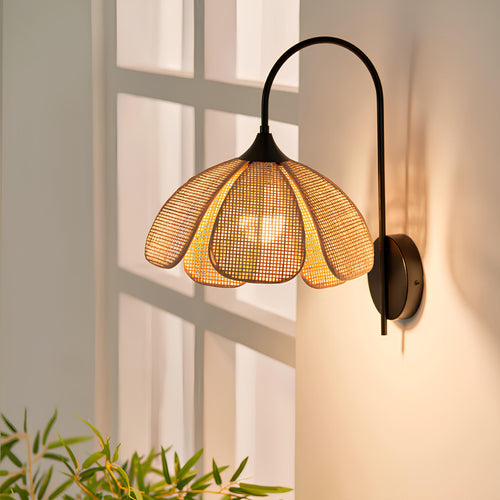
Yes, and it is the point people forget. A wall light beside a dining nook lights the table softly in the evening without the ceiling light on, and one at the kitchen entrance lights the passage for a late glass of water without flooding the room. Keep it away from the hob and sink, as with any woven shade. Our woven wall lights include slim sconces that project only a little from the wall.
For the counter itself, the best task light is an under-cabinet LED strip fitted by an electrician beneath the wall cabinets. We do not make these, but they pair well with a woven ceiling light: the strip lights the work, and the woven shade gives the room its warmth.

Projects 7.5 inches from the wall, enough to light a nook table without crowding a narrow kitchen.
Rs 2,099
Shop Now